

Disabled- and neurodivergent-led mutual aid and access infrastructure. Free tools, language, and guides for surviving bad systems, building dignity, and living authentically.
Stimpunks
You don’t have to read this site in order. Follow the doorway that fits your moment. Skimming and scrolling are encouraged.
If life feels overwhelming, start with Get Help. You don’t need to explain more than what you need.
Stimpunks is a treasure trove of everything important to the neurodivergent and disabled community.
Feedback from a reader
More testimonials
What We Do
Stimpunks builds accessible infrastructure and public tools that support disabled and neurodivergent people to live with dignity.
We provide mutual aid, creator grants, learning opportunities, human-centered research, and living wages for our community.
Who We Serve
We exist for the direct support and mutual aid of neurodivergent and disabled people.
We exist to build infrastructure that supports disabled and neurodivergent people where other systems fail.
Need Help?
Need support right now? Start here — practical coping resources, access tools, and next steps.
🆘 Crisis Mode
If you’re overwhelmed right now: pick one small next step.
Three Ways to Use Stimpunks
People come to Stimpunks for different reasons. You can explore the site in three main ways.
Understand Neurodivergent Life
Design Better Environments
- Design Method
- Design Principles
- Collaborative Niche Construction
- Pattern Recipes
- Environments
- Design Standard
Navigate Systems and Survive
Table of Contents
- Stimpunks
- Need Help?
- What Is Stimpunks?
- Find Your Path
- Explore by Experience
- Stimpunks in a Minute
- Start here if you are…
- What does “Stimpunks” mean?
- We Fix Systems
- The Stimpunks Design Method: ARLES
- The Practice Loop
- Help Us Fund Infrastructure That Systems Ignore
- Explore by Need
- How Stimpunks Works
- Mission & Philosophy
- Why?
- In Brief
- Our Lens
- Our Impact
- Testimonials
- Trust & Transparency
- Authenticity: The Freedom to Be
- Take a Walk in Our Shoes
What Is Stimpunks?
What is Stimpunks? Stimpunks is a disabled- and neurodivergent-led mutual aid and public education project. We build free language, tools, and access guides that help people survive bad systems, find dignity, and live more authentically.
We are a small, disabled-led nonprofit building infrastructure where systems fail. We operate with limited funding, a small staff, and high demand.
See where the money goes → Expand our Umbrella with a donation →
What people tell us after support:
I can’t believe how incredible y’all are. I’m in tears. This is the biggest thing that’s ever happened to me like this.
Mutual Aid Grantee (anonymous)
I want to say thank you and tell you you made a big difference in someone’s life today. I can’t stop crying. I’ve never felt understood or seen like this before. I’m desperately looking for community, perspective, support, tools to survive and feel backed into a corner.
Mutual Aid Grantee (anonymous)
Trusted By Disabled and Neurodivergent Communities • Candid Silver Seal • BBB Accountability Aligning
Most Read / Start Here
New here? These are the pages people use most—language, survival tools, and the Stimpunks worldview.
Most Read
Start Here
Pick the doorway that matches what you need today.
Follow what resonates. Keep what helps.
🗺 Tour the Site
Don’t try to read everything. Take the quick orientation.
Find Your Path
Start where you are. Pick what resonates. Or, scroll on to learn about Stimpunks.
I’m burned out
Communication is hard
I’m an educator / designer
I want to support
Want the words? Use the Glossary Map or browse the full Glossary.
A Common Path Through Stimpunks
Many people arrive here through a moment of recognition, then move toward language, support, design, and systems understanding.
Regulation
You find tools for coping and nervous system support.
Environment
You imagine and build spaces that fit real people.
Learning Spaces
Cavendish Space
Design Is Tested at the Edges
⚖️ Systems Change
You connect personal experience to power, design, and justice.
Our Lens
Broken Systems, Not Broken People
Justice & Systems
There is no single correct route through Stimpunks. This is just one common path.
Explore by Experience
Many people arrive at Stimpunks because they are trying to understand something happening in their lives. Start with the experience that feels most familiar.
- I get overwhelmed by noise, light, or crowds → Sensory Overload
- I go very deep into interests and struggle to switch tasks → Deep Attention
- I need more time to respond → Processing Time
- Socializing drains me → Social Exhaustion
- I feel chronically depleted → Autistic Burnout
- I like being with people without constant talking → Parallel Presence
- I rely on familiar foods and routines → Predictability
- I’m very strong in some areas and really struggle in others → Uneven Abilities
Want the bigger picture? Visit Experiences of Neurodivergent Life.
Stimpunks in a Minute
Through Stimpunks Foundation, we:
- Offer financial and mutual aid;
- Hire our community members as consultants;
- Provide a learning space designed for our community;
- Support our community’s open research efforts;
- Coordinate neurodivergent and disabled peer support;
- Document neurodivergent and disabled culture;
- Develop and deliver education based on lived experiences;
- Host events that celebrate neurodivergent and disabled culture;
- Hold space; and
- Provide warm lines and peer respite.
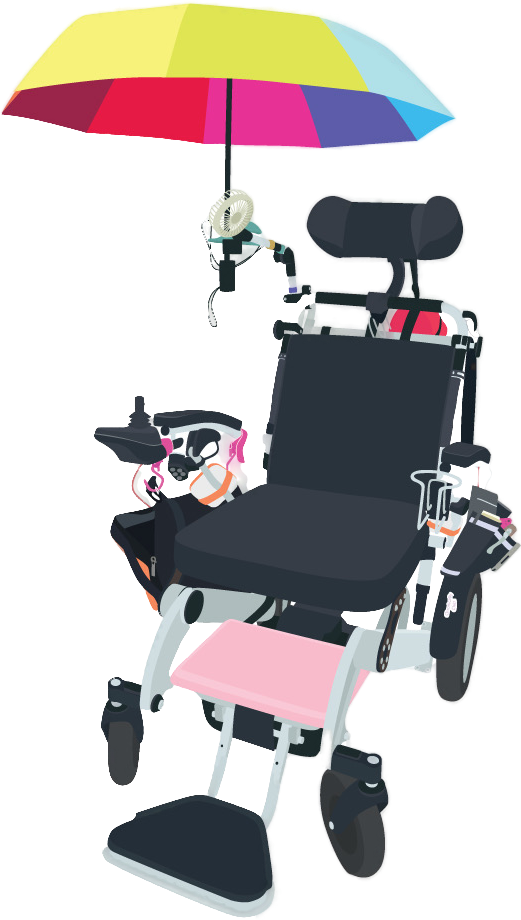
Stimpunks.org is a radically inclusive space led by and for neurodivergent and disabled people. Blending mutual aid, community care, and educational resources, we reimagine learning, working, and living through the lens of neurodiversity, disability justice, and lived experience. Our site offers rich content on neurodivergent design, sensory access, monotropism, and noncompliant pedagogy—centering voices that move through the world differently and advocating for systems rooted in access intimacy, creativity, and interdependence.
We’re here to reduce harm, increase access, and help people live more authentically.
Start here if you are…
Pick what you need right now. No wrong door. Or, keep on scrolling for more about us.
Stimpunks Foundation exists for people who don’t fit the systems they’re expected to survive. We’re a neurodivergent-led community sharing tools, ideas, and lived experience about learning, coping, and designing for real life. We reject “fixing” people and focus on changing environments instead. Take what helps, leave what doesn’t—you belong here as you are.
About our website:
We design for and encourage skimming, so skim-scroll on down and see what grabs your attention.
How We Try to Make This Website More ADHD-Friendly
In this video, Jessica discusses how she made her book more ADHD friendly.
We attempt all of these things on our website at stimpunks.org.
How I Made My Book ADHD-Friendly 🧠📘 – YouTube
- Lots of whitespace.
- Every page/screen has something breaking up the text. Break up text with pull quotes, blocks, bullets, bolding, backgrounds, images.
- Add attention getters like selective bolding and pull quotes.
- Write in conversational style.
- Organize so you don’t have to read it.
- Flip open right to your struggle. Allow people to pick up and go right to what they need.
- Format is the same for every chapter.
- Make it so people can just read the headers.
- Make it engaging and visual.
- Add in jokes and feelings.
- Put everything in one book so folks have one place to go.
What would you do to make our scrollytelling style on stimpunks.org more ADHD-friendly?
A page of neat and tidy typed text in long paragraphs is the least memorable format known.
We attempt some techniques from “Memory Craft: Improve Your Memory with the Most Powerful Methods in History” on stimpunks.org.
A page of neat and tidy typed text in long paragraphs is the least memorable format known. You need to reduce it into small segments, each made memorable by flourishes and fancy layouts. Add colour and doodles. Highlight. Enclose with clouds. Write the whole portion backwards. Do anything to make each logical entity, each verse, distinct.
Memory Craft: Improve Your Memory with the Most Powerful Methods in History
The efficacy of short sentences on a memorable page resonates with my experience as a teacher. I have found that students who read an entire paragraph of information quickly will often claim they didn’t understand it, but if they read it phrase by phrase, stopping at each comma or full stop to ensure they understand, the entire paragraph becomes meaningful. With short sentences, you are forced to engage with each element of the information and not try to grasp the whole in a single befuddling quest.
Memory Craft: Improve Your Memory with the Most Powerful Methods in History
Memory Craft: Improve Your Memory with the Most Powerful Methods in History
I’ll explain how these methods correlate with the most recent discoveries in neuroscience, which show that associating memory with place is hardwired into our brains. This common factor is why cultures all over the world have developed similar methods: they are working with the same brain structure. The neuroscience explains how we benefit from repetition and music, and in particular the value of memory palaces.
Memory Craft: Improve Your Memory with the Most Powerful Methods in History
One of the most important lessons I have learned from indigenous cultures is the value of strong characters in stories. I cannot emphasise enough how useful this is.
Memory Craft: Improve Your Memory with the Most Powerful Methods in History
Indigenous cultures around the world don’t just use the vast landscape as a memory palace; they use a wonderfully integrated system of objects—portable memory devices—that are often simply referred to as ‘art’ and seen to have little practical purpose.
Memory Craft: Improve Your Memory with the Most Powerful Methods in History
many objects interpreted simply as artworks are mnemonic landscapes in miniature.
Memory Craft: Improve Your Memory with the Most Powerful Methods in History
If you want to remember what you’ve written down then take the lessons offered in the medieval manuscripts and turn your page into a memory space.
Memory Craft: Improve Your Memory with the Most Powerful Methods in History
The wilder, the more colourful and active, the more grotesque, vulgar or erotic the images and stories you create are, the more memorable they will be. That is the secret to making knowledge memorable.
Memory Craft: Improve Your Memory with the Most Powerful Methods in History
To memorise any information, you need to first organise it into little chunks that flow in a logical order.
Memory Craft: Improve Your Memory with the Most Powerful Methods in History
A memory palace is a structure, grounded in the landscape, offering a firm base on which to build a tower of knowledge to play with, analyse and think about—a way to ponder the big picture.
Memory Craft: Improve Your Memory with the Most Powerful Methods in History
The big lesson of this chapter is: don’t make nice neat notes. Decorate and doodle all over them.
Memory Craft: Improve Your Memory with the Most Powerful Methods in History
As in classical times, memory training involved associating information with emotionally striking images in a set of ordered physical locations.
Memory Craft: Improve Your Memory with the Most Powerful Methods in History
Can’t we optimise our thinking by making the best use of all three: memory, writing and computer technology?
Memory Craft: Improve Your Memory with the Most Powerful Methods in History
But most important of all, the pages of the text had to stir the emotions to make the written word unforgettable.
Memory Craft: Improve Your Memory with the Most Powerful Methods in History
The elaborately decorated lists of numbers were written between illustrations of columns with arches above, reflecting the ancient memory advice to use inter-columnar spaces as locations for memory images. The vertical spaces between the columns were then divided by horizontal lines into small rectangular spaces, each holding no more than five items, the maximum number suggested for retaining in memory for a single location.
Memory Craft: Improve Your Memory with the Most Powerful Methods in History
Laying out the narrative in a grid of images makes it more memorable. Your brain will remember where a given rectangle in the grid lies in the space and hence recall the information.
Memory Craft: Improve Your Memory with the Most Powerful Methods in History
Many of the stories are painted in grids, some of the most famous examples being three cells by four cells, as in Plate 23. The images are not only unique but positioned in a unique location on the page.
Memory Craft: Improve Your Memory with the Most Powerful Methods in History
Hugh recommended using grids of cells to memorise large swathes of text. For example, for the 150 psalms, he recommended that the beginning phrase of the first verse be placed in a cell. The cells were placed in a line of 150 locations. For each psalm, he then imagined another set of numbered cells, one for each verse.
Memory Craft: Improve Your Memory with the Most Powerful Methods in History
Memory Craft: Improve Your Memory with the Most Powerful Methods in History
Whenever you need to learn an abstract theme, give it a character.
Memory Craft: Improve Your Memory with the Most Powerful Methods in History
The secret to memorising anything is to break the information down into memorable portions; just focus on a snippet at a time.
Memory Craft: Improve Your Memory with the Most Powerful Methods in History
In the pious Middle Ages, violent, lewd and fanciful images were deemed highly inappropriate. I am delighted to report that Albertus justified their use because, ironically, they were so effective for memorising moral philosophies.
Memory Craft: Improve Your Memory with the Most Powerful Methods in History
In her seminal work, The Art of Memory, Frances Yates wrote: ‘If Simonides was the inventor of the art of memory and “Tullius” its teacher, Thomas Aquinas became something like its patron saint.’1
Memory Craft: Improve Your Memory with the Most Powerful Methods in History
That’s the big lesson from Thomas Aquinas: meditate. Go over your journeys and palaces, your memory boards and songs, but do it gently and slowly.
Memory Craft: Improve Your Memory with the Most Powerful Methods in History
Our Storytelling Conventions
We love hyperlinks and use them extensively. We consider them a kindness to the reader and a potent weapon in the fight against disinformation. Many of our links lead to our expansive glossary.
We love Stimpunks, their Glossary is a rich source of information presented through an affirming lens. Be more Punk! 🤘🏻✊🏾 https://stimpunks.org/glossary-list/#h-all-glossary-entries
Pebble Autism on X
We use block quotations (blockquote) heavily. We quote our favorite passages and sources with hyperlinks signposting back to the original work.
We also heavily use “accordions”. Accordions contain more in depth information on a topic that you can reveal at your own pace.
We often break paragraphs of text down into bulleted lists that present one idea per line in plain language.
We provide content hierarchy, visual hierarchy, and tables of contents.
We are iterating toward “digital stories” and “Web-Based Conceptual Portmanteau”.
Consume this content to the depth and breadth of your preference in whatever way and order works for you.
This website is a living document that you can contribute to under a Creative Commons CC BY-SA license. Send us your suggestions and favorite quotes and resources.
We provide “Main Takeaways” on many pages. Main takeaways are presented with one idea per line in a bulleted list format. If you don’t have time or energy to read an entire page, reading just the main takeaways will give you what you most need to know.
Readers on the web scan for information, rather than reading everything line-by-line. Chunking your content into smaller sections, called out by larger headings, helps them find the information they’re searching for.
When I’m trying to find something quickly, there’s nothing more intimidating than jumping onto a site with a giant wall of unbroken content.
Show, Don’t Tell | CSS-Tricks – CSS-Tricks
Where possible, break down paragraphs into lists. Lists make scanning easier!
Show, Don’t Tell | CSS-Tricks – CSS-Tricks
bold the most important part of a sentence to make sure that readers scanning through your content catch their eyes on what’s most important.
Show, Don’t Tell | CSS-Tricks – CSS-Tricks
Show, then tell. Start with concrete examples & pictures, then lay down the abstract definitions.
Nutshell: make expandable, embeddable explanations
Our Rules for Scrollytelling
- Accordions expand/infodump on a topic without interrupting the main flow.
- Accordions labelled “What is…” provide definitions, context, and further reading.
- Accordions labelled “In other words…” explain things in different ways, including easy read, one idea per line, and plain language summaries.
- One line inline definitions are offered.
- Explanatory items are grouped into “What does this mean?” blocks.
- Related items are grouped together on a colored background with a group title. This makes it easier to tell what’s in a group and skim past it.
- Pick colors for groups based on colors in included media, if any.
- Pick colors for groups of accordions based on themes like rainbow.
- Lots of whitespace.
- Every page/screen has something breaking up the text.
- Selective bolding of key sentences facilitates skimming.
- A table of contents is provided near the top of each page.
- Headings are used approximately every 5 screens (on a laptop) or less.
- 20 headings max.
- Put a “coming up” table of contents after 10 headings.
- Consider putting a “Bodymind Break” section after 10 headings.
- Spacers are used as pause points, fermata.
- Spacers are used before headings to accentuate the break.
- Long scrollytelling stories signpost to what’s ahead.
- Break up text with pull quotes, blocks, bullets, bolding, backgrounds, images.
- Use lists to present one idea per line.
- Make it so people can just read the headers, table of contents and get the gist of the page/section.
- Make it engaging and visual.
- Write in a conversational style.
- Add in jokes and feelings.
There’s more about our scrollytelling conventions in our explainer at “📚🌈♿️ An Encyclopedia of Disability and Difference”
Content on our website is structured in a multimedia, multi-modality, scrollytelling style. Scrollytelling is the fusion of scrolling and storytelling: a way to dynamically tell long-form stories as the user scrolls.
Our vertical storytelling style is inspired by webtoons. Read the bolded text as you scroll for a scrolling pace similar to webtoons.
To get more detail on things that interest you, read the surrounding text, explore the accordions, and follow links to other parts of our website.
Main concepts are presented at the top of the page in plainer language, with more academic language and further detail provided as you scroll down.
Read to the depth you’re comfortable with.
If you don’t have time to rabbit hole an entire page or section, read what you can knowing that you got the main ideas up front.
“Down the rabbit hole” = getting deep into something or ending up somewhere strange
Consume this content to the depth and breadth of your preference in whatever way and order works for you.
You’re invited to read what you want and skip what you don’t. If you only scroll enough to see the headings and initial explanations, you’ll still get the essential idea. If you’re curious or have more time, the rest of the page rewards you with layered context, linked concepts, and reflections from lived experience.
For more information on our storytelling style and how we attempt to be accessible while conveying lots of information, consult our Encyclopedia page and our House Style Guide.
Our encyclopedia page explains the how and why of our storytelling. It explains our techniques for digital composition and how we combine “talk, texts, and media” (James Paul Gee) into “multimodal ensembles” (Frank Serafini) to provide vicarious learning experiences.
“Like the methods used by Stimpunks, AutCollab also makes use of montage, visual storytelling, and intertext, often in first-person forms, to provide different ways to interact with the content.”
Stenning, Anna. Narrating the Many Autisms: Identity, Agency, Mattering (The Routledge Series Integrating Science and Culture) (p. 169).
In other words…
The content on our website is designed to be engaging and accessible to a wide range of readers. We have adopted a multimedia, multi-modality, scrollytelling style, which means that information is presented in a visually engaging and interactive manner.
When you visit our website, you will notice that the main concepts are presented at the top of the page using simpler language. This allows you to quickly grasp the key ideas without getting overwhelmed by technical jargon. As you scroll down, you will find more detailed explanations and academic language for those who want to delve deeper into the topic.
We understand that everyone has different preferences when it comes to consuming content. That’s why we encourage you to read at your own pace and to the depth that you feel comfortable with. If you don’t have the time to explore an entire page or section, you can still gain a good understanding by focusing on the main ideas presented at the beginning.
We want you to have a flexible and customizable experience on our website. Feel free to consume the content in any way and order that works best for you. Whether you prefer to skim through the main points or dive into the nitty-gritty details, our goal is to provide you with valuable information in a format that suits your needs.
Accordions labelled “In other words…” explain things in different ways, including easy read, one idea per line, and plain language summaries.
Stimpunks Foundation is a neurodivergent-led nonprofit working to reduce harm caused by systems that ignore real human needs. We create practical frameworks, field guides, and cultural tools grounded in lived experience—so people can learn, work, and live without masking or burning out. Your support funds care infrastructure, accessible publishing, and honest, public accountability. We don’t chase scale for its own sake—we invest in what actually helps.
Stimpunks is an essential resource for educators.
Ira David Socol (author of Timeless Learning and Designed to Fail: A History of Education in the United States)
Stimpunks Foundation is a learning space built by neurodivergent and disabled people for anyone questioning how school, work, and design are supposed to function. We offer plain-language frameworks, field guides, and tools that foreground complexity, access, and real-life conditions. Our work challenges compliance-based education and replaces it with approaches rooted in autonomy, sensory access, and dignity. If traditional systems aren’t working for your students, you’re in the right place.
They don’t take #DisabilityStudies classes.
Karrie Higgins
They don’t socialize with us.
They don’t listen to us.
Stimpunks Foundation offers perspectives you won’t find in clinical guidelines—because they come from people living inside the systems you work in. We share lived experience, practical frameworks, and language that can help you reduce harm, improve communication, and design care that works in real life. This is not diagnostic guidance or compliance training; it’s an invitation to listen, reflect, and do better alongside the people you serve.
Stimpunks Foundation is built by neurodivergent and disabled people working at the pace their lives allow. We value lived experience, honesty, and care over polish or productivity. Contribution here is flexible, consent-based, and supported with real infrastructure—not pressure or guilt. If you want to help build tools that reduce harm and make room for real lives, you’re welcome.
We work in public, default to open, and name constraints early. Tasks are scoped to real capacity, timelines are flexible, and rest is not a failure state. We encourage asking for help, changing your mind, and stepping back when needed. Credit is shared, power is examined, and care comes before output—because sustainable collaboration is the work.
Stimpunks Foundation is a space made with and for people who’ve been told to adapt endlessly to systems that won’t adapt back. We share lived experience, practical tools, and hard-earned language for surviving, learning, and building together. This isn’t about fixing yourself or performing productivity—it’s about care, honesty, and making room for real human needs. Come as you are. Take what you need. Add what you can.
Stimpunks Foundation is here for people who are overwhelmed, burned out, or falling through the cracks of systems that don’t work for them. We don’t have all the answers, and we can’t fix everything—but we can offer understanding, practical tools, shared language, and pathways to support. You don’t have to explain or justify your needs here. Start where you are. Take what helps. You’re not alone.
Accountability Is Care → Where the money goes, annual reports, policies.
What does “Stimpunks” mean?
stimming = self-stimulatory movements and expressions that help self-regulation; the repetition of physical movements, sounds, or words, or the repetitive movement of objects
Stimpunks combines “stimming” + “punks” to evoke open and proud stimming, resistance to normalization, and the DIY culture of punk, disabled, and neurodivergent communities. Instead of hiding our stims, we bring them to the front.
Everything that was normally supposed to be hidden was brought to the front.
PUNK SUBCULTURE – WIKIPEDIA
Punk has always been about dragging the truth into the light—showing the wires, the scars, the labor, the mess. It’s about rejecting the lie that systems are neutral and exposing who pays the cost when they pretend to be.
The term “Stimpunk” itself is a fusion of “stimming” and “punk,” symbolizing a proud embrace of behaviors and identities that mainstream culture frequently stigmatizes. By bringing to the forefront what is typically hidden—such as stimming behaviors—Stimpunks fosters an environment where individuals can express themselves without fear of judgment.
That’s what the name “Stimpunks” means to us. Read on for how we bring the hidden to the front by pursuing authenticity, our purest freedom.
We Fix Systems
Authenticity is our purest freedom.
The Journey of Undoing: An open letter to who needs it — SITI Girl Miami
Stimpunks is a neurodivergent- and disabled-led rebellion against systems that demand conformity to grant humanity. We build community, move money directly to people who need it, and create learning and access tools that reject fixing, compliance, and forced normalcy. Grounded in the belief that authenticity is our purest freedom, Stimpunks exists to tear down ableist norms and replace them with care, autonomy, and spaces where no one has to mask to survive.
Stimpunks was truly my first encounter with a community created by and for neurodivergent & disabled people outside the context of schooling, and it changed my intellectual life forever.
It’s a DIY humanizing rebellion.
Nick Covington of Human Restoration Project
So that we may all pursue our purest freedom, we have to challenge the norm and change the narrative around people who are neurodivergent or disabled. Thus, Stimpunks. We don’t “fix” people. We fix systems. We fix access, expectations, and environments.
Fix injustice, not us. Difference isn’t a problem.
Our guiding principle is simple and measurable in impact:
When people are allowed to be authentic, outcomes improve.
We reject neuronormativity and demand the right to live and learn differently.
We, Stimpunks
The Stimpunks Design Method: ARLES
A simple way to understand and redesign neurodivergent environments.
Start by asking better questions about attention, relationships, lived experience, environments, and systems.
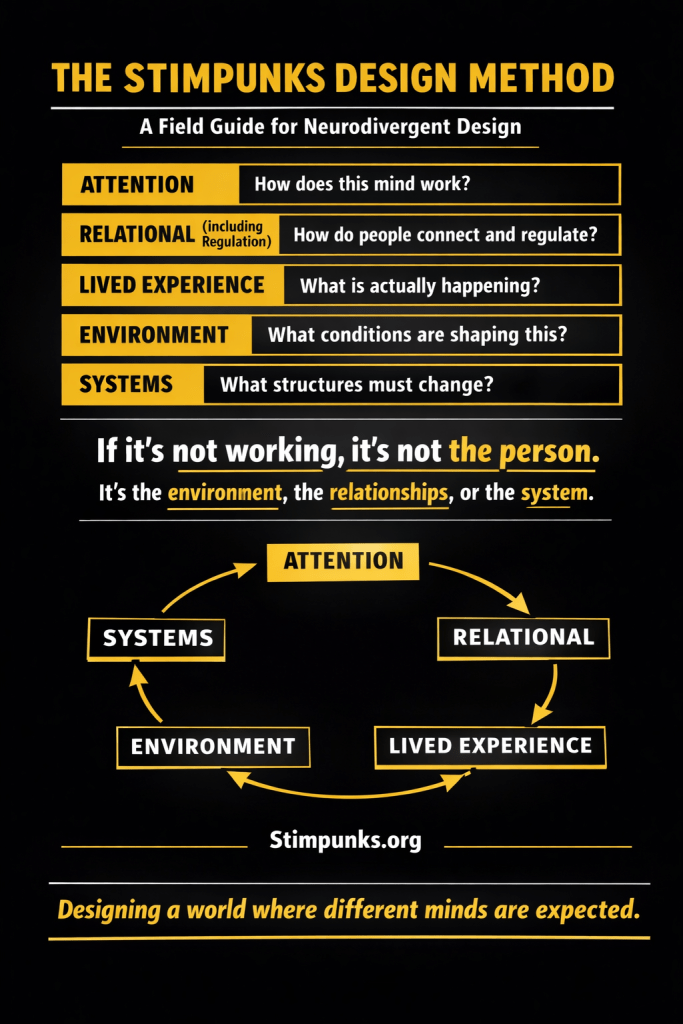
Learn the Method · Field Guide
Designing a world where different minds are expected.
A field guide for understanding and designing neurodivergent life, environments, and systems.
🧱 The ARLES Stack
Stimpunks is structured as a living design stack: from attention and relationships, through lived experience and environments, to systems that shape everyday life.
🤝 Relational (incl. regulation)
Connection, communication, co-regulation, and participation.
🌱 Lived Experience
Everyday realities of sensory, emotional, and cognitive life.
🏕 Environments
Spaces, tools, and contexts that shape participation and wellbeing.
⚙️ Systems
Institutions, norms, and structures that enable or constrain life.
Stimpunks moves from attention → relational (including regulation) → lived experience → environments → systems, designing conditions where neurodivergent life can flourish.
The Practice Loop
Once you understand the system, here’s how to use it.
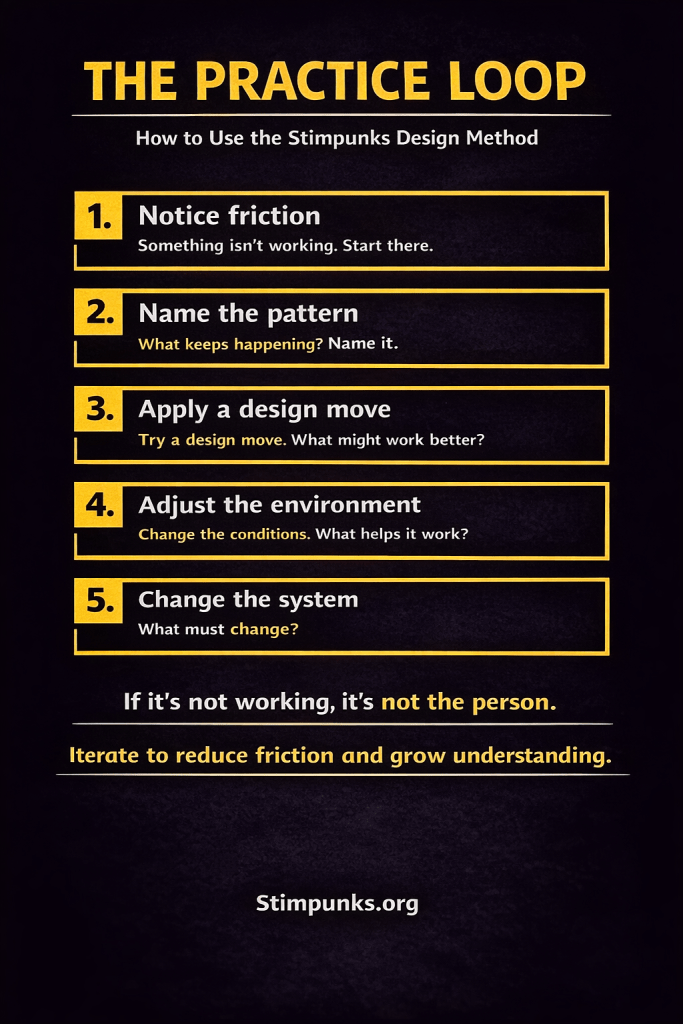
Quickstart Guide · Apply Recipes
🧰 Build Your Livable World
You shouldn’t have to fight your environment just to exist.
Most spaces aren’t built for your bodymind.
So you end up compensating, masking, and burning energy just to get through the day.
You don’t need to fix yourself.
You need a setup that works.
🔎 Step 1: Audit Your World
Start with the checklist:
→ 🧠 Livable Worlds Checklist: A Practical Audit for Building Environments You Can Exist In
Find what’s actually making your life harder.
🛠 Step 2: Fix One Thing
Don’t overhaul everything. Pick one friction point.
Start here:
- 🎒 → Sensory Kit
Regulate anywhere, not just at home - 🛋 → Pillows: Separate, Isolate, Bolster, Squeeze
Stop holding your body up all day - 🚶 → Sitting, Standing, Walking, Rolling, Hauling, Relaxing
Reduce the energy cost of moving through the world - 🍽 → Dressing, Eating, Hydrating, Hygiene
Make care possible on low-energy days
🔁 Step 3: Test and Adjust
Go back to the checklist.
Did anything get easier?
- If yes → keep building
- If no → try a different lever
🧠 What You’re Doing
You’re not optimizing yourself.
You’re building a world where:
- you can stay regulated
- you don’t waste energy on friction
- you don’t have to hide what you need
🌱 If You Want Context
- → This Chronic Bodymind: How We Cope
Why this is necessary in the first place
Help Us Fund Infrastructure That Systems Ignore
We currently fund one Mutual Aid Grant per month. Demand exceeds our budget.
Your support directly expands capacity — more grants, more regulation resources, more public tools built by and for disabled and neurodivergent people.
Explore by Need
Don’t guess where to start. Pick what you need right now.
Or, keep scrolling for more about us.
🫁 Bodymind Break
Take a moment to check in with your bodymind.
Do what you need:
- move, stretch, stim
- drink water or eat
- rest your eyes
- leave and come back
You don’t need permission.
Your bodymind has needs.
Those needs deserve to be met.
How Stimpunks Works
Stimpunks is organized as a design ladder.
Each layer builds on the one below it.
Experiences
How neurodivergent life actually feels.
↓
Patterns
Recurring structures of neurodivergent life.
↓
Recipes
Practical ways to design better environments.
↓
Environments
Where patterns and recipes come together.
↓
Design Systems
Frameworks for redesigning institutions.
↓
Civilization
What society might look like if difference were expected.
Mission & Philosophy
These are our guiding documents.
Staying alive is a lot of work for a disabled person in an ableist society.
(Wong, 2020)
Stimpunks puts resources directly into the hands of neurodivergent and disabled people to reduce harm, remove barriers, and make thriving possible.
Stimpunks is created by and for neurodivergent and disabled people.
We provide mutual aid, creator grants, learning opportunities, human-centered research, and living wages for our community.
We believe that direct support to individuals is the most effective approach to alleviating the barriers and challenges that prevent neurodivergent and disabled people from thriving.
We provide direct, material support—mutual aid, creator grants, learning opportunities, human-centered research, and living wages—so our community can survive and thrive in a world not built for us. We presume competence, honor self-determination, and recognize that staying alive is real work in an ableist society. Our mission is to offer real help against that onslaught by putting resources directly into the hands of individuals, because direct support is the most effective way to dismantle barriers and make thriving possible.
I center the marginalized and the different. I center edge cases, because edge cases are stress cases and design is tested at the edges. I center neurodivergent and disabled experience in service to all bodyminds.
We pledge to act and interact in ways that contribute to an open, welcoming, diverse, inclusive, and healthy community.
We steer by these acquired phrases. They are compasses and stars that align us on our mission.
This is a manifesto that begins but will never end. This is a translation of my world into yours. This is a protest of the notion that there is any correct way to live. We reject neuronormativity and demand the right to learn and live differently.
- Authenticity Is Sacred
Being fully oneself is not a flaw, phase, or failure. Authenticity is our purest freedom and deserves protection. - Nothing Is Neutral
Systems, norms, and designs always choose winners and losers. We name power instead of pretending it isn’t there. - People Are Not the Problem
When someone is struggling, the environment is suspect first. Fix systems before fixing humans. - Care Comes Before Compliance
Rules that harm people are not virtues. Care is a higher good than obedience. - Interdependence Over Independence Myths
No one survives alone. Needing help is human, not shameful. - Intersectionality is a Web, Not a List
Identities, systems of power, and lived experiences overlap in ways that cannot be separated into neat categories. Different forms of marginalization shape how people experience the world and how harm is distributed. - Design for Real Life
If it only works for ideal conditions, it doesn’t work. Edge cases are stress tests, not exceptions. - Rest Is Not a Moral Failure
Burnout is a systems problem. Rest is repair, resistance, and wisdom. - Lived Experience Is Legitimate Knowledge
Stories are data. Bodies remember what systems forget. - Default to Open, Not Perfect
Transparency beats polish. Learning in public beats pretending certainty. - Mutual Aid Is How We Practice Love
Care is material. We share resources, reduce harm, and build together. - Consent Is Ongoing
Participation is voluntary. You can change your mind. You can step back. - No One Has to Earn Belonging
You are not required to be productive, legible, or improving to matter. - Slowness Is a Valid Pace
Urgency is often manufactured by systems that benefit from haste. We move at the speed of trust, care, and capacity. - Clarity Is Kinder Than Niceness
Plain truth, offered with care, does less harm than politeness that obscures reality. - Boundaries Are Acts of Care
Saying no, stopping, or stepping away protects people and the work. Boundaries make sustainability possible. - Access Is a Practice, Not a Checklist
Accessibility is never finished. We adapt, listen, and revise as needs change. - Discomfort Is Not the Same as Harm
Growth can feel unsettling. Harm erases agency. We learn to tell the difference. - We Believe People About Their Own Lives
Self-knowledge is not subordinate to credentials, charts, or diagnoses. - Language Shapes Reality
Words can wound or liberate. We choose language that opens doors instead of narrowing them. - Coping Is Wisdom, Not Weakness
Coping is wisdom under pressure. Struggling in broken systems isn’t a personal failure. - Community Is Built, Not Extracted
We do not take stories, labor, or pain without reciprocity. Participation flows both ways. - Repair Matters More Than Purity
We will get things wrong. What matters is noticing, naming, and repairing harm. - Joy Is Not Frivolous
Play, humor, and delight are forms of resilience and resistance. - No One Is Disposable
People are not resources, content, or cautionary tales. Every life has weight. - We Leave Room for Mystery
Not everything needs to be explained, optimized, or solved. Some things are allowed to be complex, unfinished, or unknown. - Intersectionality Connects Every Stimpunks Tenet
It reminds us that no value operates in isolation, and no person experiences systems one axis at a time.
It is time to celebrate our interdependence. Interdependence acknowledges that our survival is bound up together, that we are interconnected and what you do impacts others. Interdependence is the only way out of most of the most pressing issues we face today.
Our designs, our societies, and the boundaries of our compassion are tested at the edges, where the truths told are of bias, inequality, injustice, and thoughtlessness.
Why?
What’s our motivation? Why do we do what we do?
We provide inclusive, community-based educational and creative opportunities for neurodivergent and disabled people. We challenge conventional systems and affirm lived experience. We believe our work offers a distinct and impactful contribution.
“Staying alive is a lot of work for a disabled person in an ableist society.” (Wong, 2020) We provide real help against the onslaught. We believe that direct support to individuals is the most effective approach to alleviating the barriers and challenges that prevent neurodivergent and disabled people from thriving in neuronormative and ableist environments. Our application process is simple, and our direct payments have the potential to transform how neurodivergent and disabled people access philanthropic capital.
Founded in 2021, Stimpunks Foundation was created by and for neurodivergent and disabled people, prioritizing autonomy, co-creation, and community empowerment. Our programming is shaped directly by those we serve, ensuring a lived-experience-centered model of support and growth. We serve neurodivergent and disabled people all over the United States and the world, offering accessible pathways for expression, education, and connection.
Our core programs include:
- Mutual Aid Initiatives: Providing direct financial support to individuals facing barriers due to ableism, ensuring they have the resources needed to thrive.
- Creator Grants: Offering financial support to neurodivergent and disabled creators across various fields, enabling them to immerse fully in their work and contribute to community enrichment.
- Learning Spaces: Establishing anti-ableist, human-centered educational environments that embrace neurodiversity and foster inclusive learning experiences.
- Open Research: Engaging in participatory, emancipatory research that amplifies the voices of neurodivergent and disabled people, challenging traditional academic narratives.
- Peer Support Networks: Coordinating support systems that connect people, fostering community and shared experiences.
- Cultural Documentation: Capturing and preserving the rich culture of neurodivergent and disabled communities, ensuring their stories and contributions are recognized.
- Educational Outreach: Developing and delivering programs based on lived experiences, providing authentic learning opportunities that resonate with our community.
We are proud of our approach that blends mutual aid, direct support, and adaptive learning environments. Unlike many service providers that operate within rigid institutional frameworks, we meet individuals where they are, honoring their pace, needs, and identities. Our organization operates through a horizontal, omnidirectional leadership structure, and all of our Directors and Board members are themselves neurodivergent and disabled—deepening our authenticity, accountability, and solidarity.
Systemic barriers in healthcare, education, and employment disproportionately harm neurodivergent and disabled people, many of whom live without adequate support or representation. Existing systems often pathologize difference rather than embracing it. Despite significant need, most funding structures overlook the transformative, grassroots work being led by neurodivergent and disabled communities.
Neurodivergent and disabled people are routinely excluded from education, employment, healthcare, and social support. The systems that claim to serve us are often built without us—and therefore fail us.
Many of us:
- Face chronic unemployment or underemployment.
- Are pushed out of schools through punitive discipline.
- Live without access to adequate housing, healthcare, or support services.
- Experience medical, educational, and institutional harm.
There is an urgent need for culturally competent, community-rooted support that affirms difference, celebrates stimming, and recognizes disability as culture—not deficit.
One in four U.S. adults have a disability. However, our community receives only 2% of US grant funding, and only 19% of us are employed. We can’t just let that be the truth. We have to challenge the norm and change the narrative around people who are neurodivergent or disabled.
Stimpunks was created to forge the way for educational inclusion and to give our community the means to survive and to thrive. We as disabled and neurodivergent people had to roll our own education, because even the “all means all” of public education failed to include us. We had to create our own care systems, because “we realized that the only people who care enough about us to work consistently for our liberation are us.” “Responsibility for the survival of entire communities lies with us.”
In Brief
Brief explanations of what we do in various formats.
What is Stimpunks?
Stimpunks is a neurodivergent- and disabled-led nonprofit that builds practical infrastructure for dignity, access, and survival.
We support people directly through mutual aid while also producing education, frameworks, and cultural resources that help systems move away from harm and toward humane, evidence-aligned practice.
Our guiding principle is simple and measurable in impact:
When people are allowed to be authentic, outcomes improve.
The Problem We Address
Neurodivergent and disabled people are routinely harmed by:
- Deficit-based medical and educational models
- Compliance-focused therapies and institutions
- Inaccessible environments and communication norms
- Systems that require masking, self-erasure, or crisis to receive support
These conditions lead to burnout, poor health outcomes, disengagement from education and work, and unnecessary dependence on crisis services.
Our Approach
Stimpunks works at both the individual and systems level:
- Immediate support to reduce harm and instability
- Education and reframing to prevent future harm
- Community-driven design to ensure relevance and trust
We do not “fix” people.
We fix access, expectations, and environments.
Programs & Activities
❤️ Mutual Aid & Direct Support
- Direct financial assistance to neurodivergent and disabled people
- Creator and community grants
- Fast, low-barrier support that prevents escalation into crisis systems
Impact: Stabilization, reduced stress, improved capacity to engage in life, work, and care.
🧠 Learning Pathways & Educational Resources
- Neuroaffirming learning pathways (autism, ADHD, neurodiversity, access)
- Grounded in lived experience and contemporary research
- Freely accessible, globally used
Impact: Improved understanding, reduced stigma, better decision-making by families, educators, and professionals.
🧱 Access-Centered Frameworks
- Communication access
- Sensory and spatial access
- Education and healthcare access
- Psychological safety as a design requirement
Impact: Increased participation, reduced exclusion, fewer behavioral and disciplinary interventions.
🧑🤝🧑 Community & Cultural Documentation
- Storytelling and scrollytelling grounded in lived experience
- Language and frameworks that replace deficit narratives
- Trust-based community engagement
Impact: Stronger identity development, belonging, and resilience among marginalized populations.
What Makes Stimpunks Distinct
- Led by the communities served
- Combines direct aid with long-term systems change
- Rejects coercive and compliance-based models
- Centers psychological safety as a core outcome
- Low overhead, high trust, high relevance
We align closely with disability justice, trauma-informed care, and evidence showing that autonomy and safety improve long-term outcomes.
Who We Serve
- Autistic, ADHD, and neurodivergent people
- Disabled people across bodymind differences
- People questioning identity or diagnosis
- Families and professionals seeking non-harmful approaches
- Institutions willing to reform ableist practices
Outcomes Funders Support
- Reduced crisis intervention and burnout
- Increased engagement in education, work, and community
- Improved wellbeing through access and autonomy
- Sustainable, community-owned support systems
- Scalable, open educational resources
Bottom Line
Stimpunks invests in people and the conditions that allow them to thrive — not in systems that demand conformity.
Funding Stimpunks supports immediate relief and durable cultural change, led by those most affected.
Donate
Organization Overview
Stimpunks is a neurodivergent- and disabled-led nonprofit that builds practical infrastructure for dignity, access, and survival. We support neurodivergent and disabled people through direct mutual aid while also producing open educational resources and access frameworks that reduce systemic harm. Our work is grounded in lived experience, disability justice, and a simple principle: when people are allowed to be authentic, outcomes improve.
Statement of Need
Neurodivergent and disabled people are routinely harmed by deficit-based medical, educational, and social systems that prioritize compliance over wellbeing. These systems often require masking, self-erasure, or crisis to access support, leading to burnout, poor health outcomes, exclusion from education and employment, and overreliance on emergency services. While resources exist, many are inaccessible, coercive, or disconnected from lived experience. There is a critical need for supports that are humane, low-barrier, and designed by the communities most affected.
Program Description & Approach
Stimpunks addresses this need through a dual strategy:
- Immediate stabilization through direct support, and
- Long-term harm reduction through education and access-centered frameworks.
Rather than attempting to “fix” individuals, Stimpunks focuses on changing conditions — access, expectations, and environments — so people can participate safely and authentically.
Key Activities
- Mutual Aid & Direct Support:
Provide low-barrier financial assistance and creator grants to neurodivergent and disabled individuals to reduce crisis, stress, and instability. - Learning Pathways & Educational Resources:
Develop and maintain free, neuroaffirming learning pathways on autism, ADHD, neurodiversity, and access, grounded in lived experience and contemporary research. - Access-Centered Frameworks:
Produce practical guidance on communication, sensory and spatial access, education access, healthcare access, and psychological safety. - Community & Cultural Documentation:
Center disabled and neurodivergent voices through storytelling and shared language that counters deficit-based narratives.
Outcomes & Impact
Funding Stimpunks supports outcomes including:
- Reduced burnout and crisis escalation
- Increased participation in education, work, and community life
- Improved wellbeing through autonomy and psychological safety
- Greater understanding and reduced stigma among families and professionals
- Scalable, open resources that prevent harm before it occurs
Organizational Strengths
Stimpunks is led by the communities it serves, ensuring relevance, trust, and accountability. We combine direct aid with systems-level education, maintain low overhead, and prioritize transparency and accessibility. Our work aligns with disability justice, trauma-informed practice, and evidence showing that autonomy and safety improve long-term outcomes.
Conclusion
Stimpunks invests in people and the conditions that allow them to thrive. Grant support enables immediate relief while building durable, community-owned alternatives to systems that demand conformity. This funding advances both human dignity and sustainable impact.
Donate
1. Your money goes directly to people, not bureaucracy
Stimpunks practices mutual aid, not charity theater. Donations are moved quickly and with low barriers to neurodivergent and disabled people who need relief now—for rent, food, care, survival. This prevents crises before they become emergencies, which is both more humane and more effective than downstream interventions.
Impact: Immediate stabilization, reduced stress, fewer crisis escalations.
2. Stimpunks fixes conditions, not people
Most systems are built around compliance: behave correctly, mask well, suffer quietly, and maybe you’ll get help. Stimpunks rejects that model entirely. It invests in access, psychological safety, and autonomy, which research and lived experience both show lead to better long-term outcomes.
Your donation supports:
- Communication access
- Sensory and space access
- Education and healthcare access
- Environments where people don’t have to erase themselves to survive
3. It’s led by the people most affected
Stimpunks is neurodivergent- and disabled-led. That means:
- No guessing what people need
- No extractive storytelling
- No top-down “solutions” that create harm
Lived experience isn’t a side note here—it’s the operating system.
Result: Higher relevance, higher trust, higher impact per dollar.
4. It prevents harm instead of managing fallout
Compliance-based therapies, inaccessible systems, and deficit narratives cost people their health, education, jobs, and lives. Stimpunks intervenes upstream by:
- Publishing open, neuroaffirming learning pathways
- Challenging harmful practices
- Giving families, educators, and professionals better tools
Prevention is cheaper, kinder, and more effective than repair.
5. Your donation creates compounding impact
Stimpunks doesn’t just help individuals—it builds shared infrastructure:
- Free learning resources used globally
- Language and frameworks that change how people think and act
- Community knowledge that outlives any single grant
One donation helps one person and strengthens the ecosystem that supports thousands more.
6. This is accountability without gatekeeping
Stimpunks operates with transparency, low overhead, and a clear ethical spine. There’s no pressure to sanitize stories or soften the truth to appease funders. Donations support honest work rooted in dignity, not optics.
7. Because people shouldn’t have to mask to deserve care
At the deepest level, donating to Stimpunks is a values decision.
It says:
- People are not broken
- Difference is not a defect
- Care should never be conditional on conformity
Authenticity is our purest freedom—and freedom requires resources.
Bottom line
If you want your money to:
- Reach people fast
- Reduce harm instead of rebranding it
- Support work led by those who live it
- Build something real, not polite
Donate to Stimpunks.org.
How many people do you serve?
We don’t reduce people to counts. We focus on whether our work is used, shared, and adapted in real-world settings—and whether it reduces harm.
What measurable outcomes can you prove?
We document learning, adoption, and qualitative change. Our outcomes are often cultural, educational, and systemic, not short-term or linear.
How do you ensure accountability?
We default to open: public goals, public updates, transparency logs, and honest reflection on what worked and what didn’t.
How do you scale?
We scale ideas, not extraction. Our resources are designed to spread without burning out the people who create them.
How do you know your work matters?
Because people tell us—and because they keep using, remixing, and teaching with what we make.
This crosswalk translates common grant application prompts into how Stimpunks Foundation actually answers them—without flattening our work or our people.
Mission / Purpose
Grant prompt: Describe your organization’s mission and goals.
Our answer: We aim to reduce harm and increase access for neurodivergent and disabled people by changing how systems think, design, teach, and work.
Programs / Activities
Grant prompt: What programs do you run?
Our answer: We publish field guides, frameworks, and cultural tools grounded in lived experience, supported by care infrastructure that enables participation.
Population Served
Grant prompt: Who do you serve and how many?
Our answer: We serve neurodivergent and disabled people, and the educators, designers, families, and workers who learn from our resources. Reach is demonstrated through use, reuse, and adaptation—not headcounts.
Outcomes / Impact
Grant prompt: What outcomes do you achieve?
Our answer: Reduced harm, increased understanding, and practical change in how environments are designed and navigated. Outcomes are often qualitative, cultural, and systemic.
Evaluation
Grant prompt: How do you measure success?
Our answer: Through qualitative feedback, evidence of adoption, public reflection, and transparent documentation of learning over time.
Accountability / Governance
Grant prompt: How are you accountable to stakeholders?
Our answer: We default to open—publishing goals, updates, budgets, and reflections publicly, and centering lived experience in decision-making.
Sustainability / Scale
Grant prompt: How will this work grow or sustain?
Our answer: We scale ideas and access, not extraction. Sustainability means protecting people from burnout while enabling knowledge to spread.
Our Lens
These are Stimpunks’ core ideas, framed as short briefs to support understanding. Each brief explains how we understand autism, disability, care, and systems differently—grounded in lived experience.
These are not neutral definitions. They are tools for perceiving differently.
This is our lens.
Our Impact
- Number of mutual aid grants: 110
- Amount of mutual aid grants: $67,850
- Number of creator grants: 14
- Amount of creator grants: $42,000
- Amount of all grants: $109,850
- Number of web pages published: 1,305
- Number of Google Scholar citations: 65
Testimonials
A good measure of any movement is in the stories of the people it touches. In this section, community members, grantees, and allies share what Stimpunks has meant to them — from places of liberation and joy to moments of profound connection and belonging. Their voices reflect how our work shows up in real lives, affirming that this is not just a website, but a humanizing rebellion led by and for neurodivergent and disabled people.
As Stimpunks have shown, cultural agency is developed through pedagogy, activism, language, and creative practice, and it has the potential to expand what we think of as the social.
Stenning, Anna. Narrating the Many Autisms: Identity, Agency, Mattering (The Routledge Series Integrating Science and Culture) (p. 193).
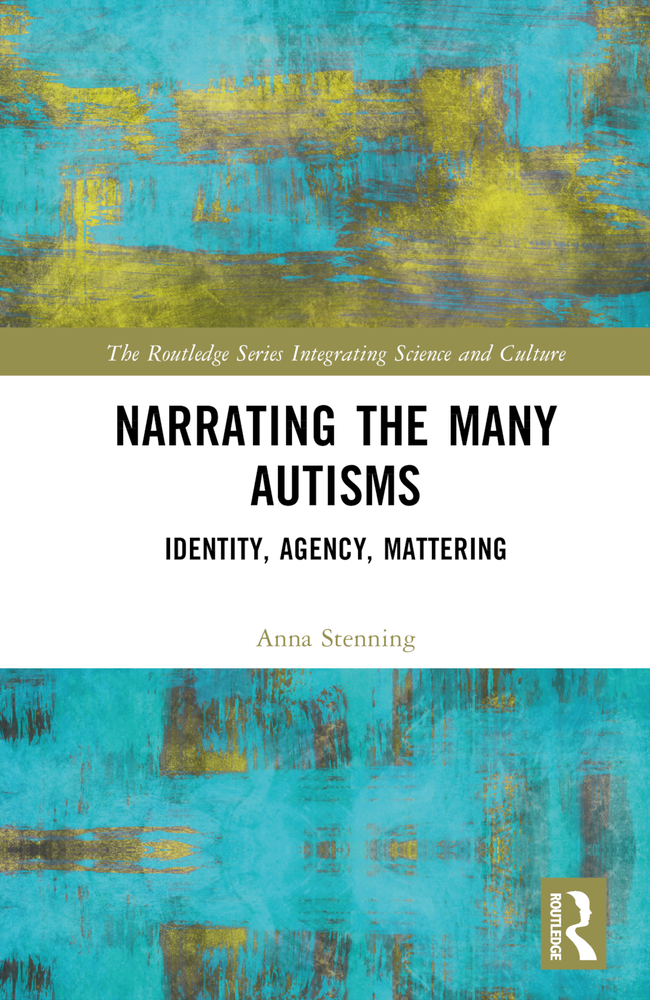
As ‘self-consciously subversive bricolage’ (Stimpunks), it paves the way for collective forms of expression that are modular and lively.
In what follows, I explore the authorship of web technologies (in the form of WordPress websites) to create alternative social networks by and for neurodivergent communities. These two domains rely not only on web coding, information architecture skills and knowledge gained in technology fields but also the understanding of cultural and social practices that exist in other disciplines. Two of their co-authors – Jorn Bettin and Ryan Boren– have ‘hacked’ their careers in technology fields so that they can dedicate their lives to social justice. Similarly, autistic researchers from around the world who have been trained in cognitive psychology, education, literature, creative writing, and sociology are supplementing disciplinary training with philosophical inquiry to challenge the implicit and widespread assumption that autism and neurodiversity more generally can only be studied through the methods of cognitive psychology.
As examples of modular and animating institutions, I refer to the organizational operating model proposed by Jorn Bettin, from the Autism Collaboration Trust (AutCollab), as part of the NeuroDiventures Project. I argue that the model supports ‘transversal’ relations, which are characterized by the ways that power and roles are disrupted’ (Wolf-Meyer 2020: 64) by neurodivergent member-employees working toward a common goal. In terms of facilitation, I provide examples from Stimpunks, who offer ‘Mutual Aid and Human-Centered Learning for Neurodivergent and Disabled People’, by implementing the operating model provided by AutCollab (2023).
Like the methods used by Stimpunks, AutCollab also makes use of montage, visual storytelling, and intertext, often in first-person forms, to provide different ways to interact with the content. AutCollab and Stimpunks demonstrate how sharing knowledge about autism or neurodiversity more generally is made possible by institutional arrangements that facilitate individuals with diverse capacities and interests.
Organizations such as Stimpunks and AutCollab facilitate connections, between individuals to counter the isolation and perceived burdensomeness that many autistic people experience through dominant social practices.
Drawing on ideas from AutCollab, Stimpunks, the Autistic Task Force and Wolf-Meyer’s writing on modular institutions, I explore how the idea of ‘conviviality’, as autonomy within interaction, can apply to autistic people’s distinctive ways of responding to the world and a cooperation across neurotypes and cultures.
While I focus in this chapter on AutCollab, Stimpunks, and the Global Autistic Taskforce, there are many other organizations which connect neurodivergent academics globally and regionally and which are working to produce tools to unravel the assumption that there is a singular pathway to becoming a valuable human subject. Like the organizations introduced below, there is seldom a singular focus on neurodiversity, and participants bring their insights into the need to recognize the intersections of atypical subjectivity with differences in ethnicity, sexuality, and gender identity. Together, these organizations themselves suggest models for how we might create institutions that can support atypical forms of learning, working, and playing.
Recognizing the injustice of the enforced ‘neurotypicalization’ of neurodivergent and disabled people, Stimpunks focuses on four pillars to support collective efforts to ‘forge our own community’: mutual aid, ‘designing for the edges’, open research, and a diversity consultancy (Stimpunks homepage: n.d.). While the charity also provides financial aid to members, the majority of content refers to the possibilities of a ‘DIY culture’ drawn from many sources: disability activism, punk, and critical pedagogy. One of the founders, Ryan Boren, is a retired technologist and former senior coder at WordPress.
Many of the charity’s activities focus on the notion of ‘reframing’, and the creation of a shared language to enable both self-care and social change (Boren 2020). The reframing works not only at the level of the Neurodiversity Paradigm but in terms of a broader ‘structural ideology’ (ibid). This ideology is intended to shift thinking beyond the ‘attribution error’ of regarding behaviors as resulting from individual dispositional or mindset factors rather than ‘situational factors’ resulting from the social environment and influenced by ‘policies, norms, systems, and other structural realities’ (Boren 2021). Boren notes that the misleading ‘mindset’ mentality is evident in the demand for mindfulness as a solution for the stress that people experience as a direct result of external factors. Boren advocates a political response through design aimed at the ‘edge’, where:
[O]ur societies, and the boundaries of our compassion are tested at the edges, where the truths told are of bias, inequality, injustice, and thoughtlessness. (Stimpunks ‘Edges’)
Stimpunks addresses the idea of how education may provide ‘psychological & sensory safe spaces’ that simultaneously provide opportunities for ‘intermittent collaboration’, rather than enforced large group interactions, and ‘collaborative niche construction’. For Stimpunks, the latter means creating the ‘least restrictive environment’ that enables the recognition of all students’ strengths, while at the same time engineering the environment to support the vulnerabilities of all learners. This acknowledges that individuals vary according to sensory sensitivity and will benefit from the development of three distinctive archetypal learning places to maximize possibilities for all learners (not only the ‘neurodivergent’) within both online and physical environments: these as the campfire, cave, and watering hole.
The cave, in particular, is suited to autistic learners or ‘orchids’, who are most susceptible to outside influences: it represents a quiet space where students can retreat to reflect on what they have experienced and engage in a ‘maker’s schedule’ rather than one that is dominated by the instructor. The campfire signifies a situation in which learners share learning in a small group of peers. The watering hole is a space that allows access to a broader ‘common space’, providing an opportunity for ‘intermittent collaboration’ that has been shown to benefit all learners (Stimpunks ‘Cavendish Spaces’).
While I focus on texts written by Bettin and Boren, both the Stimpunks and AutCollab websites feature a wide range of narrators, artists, musicians, and commentators, with external links to blog posts, Tweets, and YouTube channels. The Stimpunks website, in particular, offers multiple points of access to and ways through its content and beyond, with key definitions presented in different media, including an ‘ear read’ and a ‘plain text’ format. AutCollab focuses on linguistic and cultural plurality and has made key content available in seven languages. Each website is organized around modules of overlapping themes, and AutCollab provides the opportunity for feedback and critique. Both organizations provide material free at the point of access.
I wish to highlight the contrasting approaches to the development of knowledge and technology to support autistic people: on the one hand the ‘pathogen’ model of autistic populations, on the other the community approach to autistic collaboration advocated by Stimpunks and AutCollab. The Lancet Commission’s approach to technology centers on its potential to capture, and potentially minimize, the costs and risks associated with autism in general. Technology seems to serve the role of controlling autistic bodies so that they may be seen to conform to neurotypical social norms (even while this runs the risk of creating further autistic pathologies, such as screen addiction (322)). The community approach, on the other hand, focuses on knowledge and technologies to facilitate connections and capacities that may support both the pursuit of individual interests and plans and collectively meaningful activities that relate to real-world challenges. In the latter case, risks, costs, and knowledge are shared (albeit differentially) by the participants in a particular project, but they are crucial part of any individual’s enjoyment in participating.
Conclusion: autistic connectivity in the Anthropocene
Narratives about a shared autistic sensibility may simultaneously serve as acts of care for those who may struggle more than we do with participation in a normative social world, but with whom we otherwise affirm kinship commonalities, and as an affirmation of political agency in resisting the imposition of dominant external narratives onto our lives. This is evident both in Joanne Limburg’s Letters to My Weird Sisters and in the collective narrative acts of the Autistic Task Force, above; it is also apparent in the Stimpunks and AutCollab websites. In each case, political agency depends on recognition – if only by our peers – of what we bring to a shared world so that we retain confidence in our understanding.
As I explored in relation to the work of Stimpunks and AutCollab, new media, in particular, provide public spaces that allow for discussions of the limitations of existing family structures when confronted with disability. Autistic-authored autobiographies can be seen not only as a development out of new online communities developed specifically by and for autistic people, but also in terms of these broader counter-normative social contexts that allow reinterpretation of concepts such as care and interdependence. Kinship imaginaries also support the development of counter-discourses about autism and other ‘severe’ neurological conditions which are not based on a reductive neuro-determinism.
I’m honestly in tears right now because of you guys.
Thank you so, so much for caring about my family. Thank you for sharing your kindness & support.
I want to say thank you and tell you you made a big difference in someone’s life today. I can’t stop crying. I’ve never felt understood or seen like this before. I’m desperately looking for community, perspective, support, tools to survive and feel backed into a corner.
Thank you for reaching out! I’m doing well – thanks to your generosity as well as some other donations I was fortunate to receive, I was able to trade my car for a van and order a lift for the wheelchair! The lift won’t be here until the end of March, but I’m SO excited to finally be free to use my wheelchair out in the world! Thank you SO much for your donation!!
Thank you so much for reaching out and I cannot express how grateful I am to have been selected! This is going to be a massive weight lifted off my shoulders!
Thank you so much for the support. I truly appreciate it! It’s really nice to connect with others who “get it” too!
I can’t believe how incredible y’all are. I’m in tears. This is the biggest thing that’s ever happened to me like this.
Oh my gosh, thank you SO MUCH! This is truly amazing!
Extremely blessed to be able to get my procedure and medication. Huge thank you to @stimpunks. I’m honestly in tears, thank you guys so much.
Thank you so much. This is exactly what I needed right when I needed it. Y’all are heros. I appreciate your help.
Thank you all so very much! This is a very beautiful thing your team is doing and gives me hope for our society.
Deeply appreciative of this and all of you at Stimpunks, thank you so much! This is an extremely impactful relief.
Again, thank you so much for everything you’ve provided. Stimpunks is doing wonderful work. Our needs may be great, but our gratitude when we receive what we need is even greater. 💕
Thank you so deeply for your help and for your care of others.
My partner told me about you and when I saw your mission page I cried for like an hour because it resonated so strongly.
It shocked me, humbled me, and made me wonder how you were able to do what you did for me!
Thank you so much @stimpunks for supporting & believing in me & my artwork.
It’s okay to be you. It’s okay to be different. It’s okay to have a disability. Never give up on yourself.
Jasmine Slater
If y’all care about me, read what @stimpunks is saying.
Liana McCrea
Huge thank you to @stimpunks for this generator so if we lose power, the oxygen concentrator can still run! I can’t thank you enough!!
Karrie Higgins
Trust & Transparency
We build in public. Our governance, finances, and impact are documented and accessible.
501(c)(3) Charity
EIN 87-4010796
Annual reports and IRS filings available.
Candid Silver Seal (2026)
Program metrics, leadership data, and financials publicly verified.
Employer Matching Enabled
Registered with Benevity and corporate match platforms.
Open Accountability
Policies, governance, and impact documentation published online.
Authenticity: The Freedom to Be
Authenticity is our purest freedom.
The Journey of Undoing: An open letter to who needs it — SITI Girl Miami
The freedom to BE, fully seen AND heard in all my glory is my heart’s deepest request. This is a prayer, self-love letter, a final notice to my inner critic, one more voice in the echo—thank you for witnessing my purest form
.The Journey of Undoing: An open letter to who needs it — SITI Girl Miami
At Stimpunks Foundation, the declaration “Authenticity Is Our Purest Freedom” serves as a guiding principle that underscores our commitment to empowering neurodivergent and disabled individuals. This ethos champions the right to self-expression and the dismantling of societal norms that often marginalize those who diverge from conventional standards.
Authenticity at Stimpunks is intertwined with the concept of interdependence. We believe that true freedom encompasses the ability to be one’s genuine self while acknowledging our interconnectedness. This perspective shifts the focus from individualism to a collective approach that values care and mutual support as essential components of a free and authentic life.
Psychological safety starts with “I don’t have to hide”.
Psychological safety means a person can exist without constantly scanning for danger:
- Will I be punished for this?
- Will I be judged, corrected, or excluded?
- Do I need to perform normality to survive?
For neurodivergent and disabled people, inauthenticity is often a survival strategy, not a choice. Masking, code-switching, suppressing stims, flattening emotions, or hiding needs all consume cognitive and emotional energy.
When authenticity is allowed, the nervous system gets a signal:
You are not under threat for being yourself.
That is psychological safety at its most basic level.
Authenticity is not self-expression for its own sake.
It is the precondition for psychological safety.
And psychological safety isn’t a luxury — it’s what allows humans, especially marginalized ones, to function, connect, and create without harm.
Masking isn’t neutral — it’s expensive.
It requires:
- Constant self-monitoring
- Predicting others’ reactions
- Editing language, tone, posture, expression
- Suppressing natural regulation behaviors
This creates continuous low-grade stress, even in “safe” environments.
Authenticity removes that tax.
Psychological safety isn’t just emotional comfort — it’s functional capacity. When people don’t have to perform, they:
- Think more clearly
- Regulate more effectively
- Participate more fully
- Recover from stress faster
Authenticity literally frees mental bandwidth.
Many authentic behaviors — stimming, silence, repetition, intense focus, blunt speech — are self-regulation strategies, not social failures.
When environments suppress authenticity:
- Regulation is blocked
- Stress accumulates
- Meltdowns or shutdowns become more likely
When authenticity is welcomed:
- Regulation happens early and quietly
- Crises are prevented rather than “managed”
- People remain within their window of tolerance
Psychological safety isn’t about comfort — it’s about regulatory permission.
Unsafe environments center an implicit rule:
“Be like us, or explain yourself.”
Safe environments flip that rule:
“You don’t owe us translation, performance, or justification.”
Authenticity becomes political here:
- Who defines “professional,” “polite,” “appropriate”?
- Who bears the cost of deviation?
Stimpunks’ framing recognizes that forcing inauthenticity is a form of control, and psychological safety requires dismantling that control, not softening it.
I’m not broken. Not a broken robot or failed competitor or weirdo whose entire life is pathologized … I’m a reasonable and excellent human being with human limits and gifts. I’m part of variety, not deviation.
A multimodal response in the final class (graduate)
(research participant, as cited in Dymond, 2025a, p. 69)
Kara Dymond: Access, agency, and wellbeing: Possibilities for neurodiversity-affirming classrooms… – YouTube
We reject neuronormativity—the idea that there is one correct way to think, learn, communicate, or exist. Schools, workplaces, and institutions are built around narrow expectations of attention, behavior, productivity, and emotional expression, and anyone who falls outside those lines is pressured to mask, comply, or disappear.
We demand the right to live and learn differently. That means honoring diverse sensory needs, communication styles, learning rhythms, and ways of engaging with the world. It means designing environments that adapt to people instead of forcing people to adapt to systems. Difference is not a deficit to be corrected—it is a reality to be respected and supported.
Take a Walk in Our Shoes
Let us be our authentic selves. Learn more about our community, our journey, and the philosophy we picked up along the way on the next page. Take a walk in our shoes so that you can see, hear, and understand us. Bring the hidden to the front, and witness our realest selves.
Take a Walk in Our Shoes
This powerful animation reveals that the barriers and solutions lie not within the young person, but in the school environment, its ethos and in peer and teacher relationships and attitudes.
Walk in My Shoes – The Donaldson Trust
We have turned classrooms into a hell for neurodivergence. Telling young neurodivergent people struggling to attend school to be more resilient is profoundly inappropriate.
Erin’s experiences shine a light on issues beyond her control that could be resolved by others; by listening and by showing they care. She could not have done more. Telling young autistic people struggling to attend school to be more resilient is profoundly inappropriate, if what you are really asking is for them to keep going under circumstances they should not be asked to endure. We need to change the circumstances.
Walk in My Shoes – The Donaldson Trust
Education Access: We’ve Turned Classrooms Into a Hell for Neurodivergence
The number of autistic young people who stop attending mainstream schools appears to be rising.
Walk in My Shoes – The Donaldson Trust
My research suggests these absent pupils are not rejecting learning but rejecting a setting that makes it impossible for them to learn.
We need to change the circumstances.
We invite you to experience the world as many neurodivergent and disabled people do—not as a thought experiment, but as a reality shaped by design, expectations, and power. These stories, simulations, and reflections show how everyday environments can exhaust, exclude, or harm when they ignore difference. The goal isn’t pity or inspiration. It’s understanding, accountability, and better choices about how we design schools, workplaces, and communities.
Through scrollytelling* — a blend of storytelling, art, and narrative media — you’re encouraged to see, hear, and feel what it means to live beyond the constraints of neuronormativity. It’s a chance to encounter our world richly and intimately, recognizing the full humanity in each voice and perspective shared here.
*Scrollytelling is the fusion of scrolling and storytelling: a way to dynamically tell long-form stories as the user scrolls.
This post is also available in:


